Imagine walking into a factory floor on a busy day. On the floor, workers operating machines and managing assembly lines. Above them, managers and executives in deep discussion in cabins and meeting rooms.
Make the management layer as sophisticated as you want, you would still need people to operate the machines. The production floor produces. The management layer coordinates. Nobody confuses the two.
Finance close has been stuck in this position for over 20 years. When Sarbanes-Oxley reshaped financial reporting in 2002, the mandate for public companies was clear: tighten controls, document everything, make the close auditable. A generation of close management software was built to answer that mandate. BlackLine, Trintech, FloQast all came out of this era. They brought real structure to a process that used to run on email threads and shared drives.
But here is what none of them ever touched: the work itself. When the close deadline hits, who pulls the data from the ERP? Who builds the accrual schedule? Who reconciles the accounts? Who posts the intercompany entries? Not the software. Your team does. Every month. 70 to 80% of your close cycle goes into that work.
If the gap is this obvious, why didn’t anyone fill it? The honest answer is that it was genuinely impossible until very recently. And now that it’s possible, the incumbents are too committed to the existing architecture to start over.
At Consark, we call this the “Execution Layer.” We built Noa, our AI execution engine, to solve for it.
Think about what a finance leader actually gets when they buy a close management platform today. A sophisticated task list. Someone needs to reconcile Account 4230. Someone needs to post the accruals. Someone needs to review intercompany and sign off on the FX revaluation. The system tracks all this beautifully. It sends reminders. It shows a dashboard with red, amber, and green. But it never touches the production floor. The industry built tools that make the close easier to manage while doing nothing to make it easier to execute.
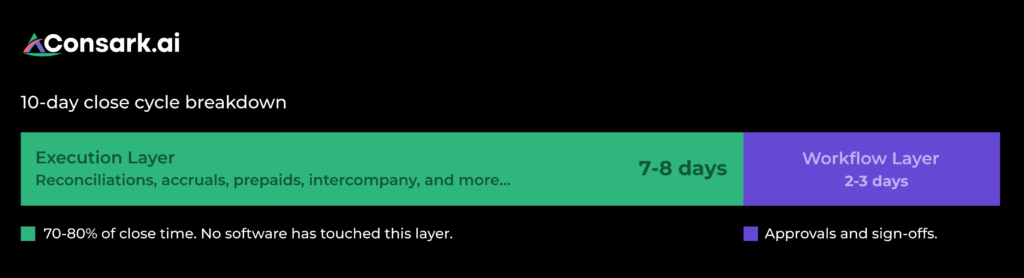
What every workflow orchestration vendor is saying is: finish the task, upload it, and we handle everything from there. Nobody is talking about the layer that performs the task.
The pain of the execution layer lives with the Controller and the staff accountant. It shows up as late night burn-out during close week due to the compressed timelines. But it never shows up in any software vendor’s demo today.
Everyone in finance software is talking about AI right now. But look at where the investment is actually going. Workflow orchestration companies have been racing to integrate AI into their existing products. Smarter dashboards, anomaly detection, workflow suggestions. All of it bolted onto the workflow layer. The architecture underneath was never designed to go deeper.
But the capability now exists to go much deeper. AI agents can now apply judgment to ambiguous financial data. They can read a contract and understand payment terms. Agents can generate the entire accrual schedule for month close. The question is not whether AI can address the execution layer. It’s that the incumbents aren’t building there. This is the difference between AI as a feature and AI as an execution engine.
This is the layer we built Noa for.
Instead of a task that says “Reconcile Account 4230, assigned to Robin, due Day 3,” you have an agent that has already pulled the GL data, run the matching logic, identified three exceptions, prepared the reconciliation workpaper, and left it ready for review. Robin’s job is now ten minutes of judgment, not three hours of assembly. The role has shifted from preparation to review. Noa turns preparers into reviewers.
40%
Close cycle reduction after deploying Noa agents
When one of our early customers deployed Noa agents, their close cycle compressed by 40%. The workflow layer didn’t get faster. The execution layer just stopped being manual.
When the execution layer is run by AI agents, finance close stops being a “cycle” with tight deadlines and moves into a continuous state. The work is always current. The deadline becomes a formality, not a fire drill. And as agents execute, structured intelligence surfaces as a byproduct: flux patterns, accrual exposures, intercompany anomalies, aging balances. The close stops being a cost center and becomes an intelligence layer.
This isn’t a “replace the accountant” story. It’s a “move the accountant from preparation to judgment” story.
Full audit trail. Full human oversight. The shift is in what they spend their time on, not whether they’re needed.
The workflow layer is going to stay. BlackLine, Trintech, FloQast solved a real problem and auditors rely on them. But in the new AI-native world, the execution layer does the work while the workflow layer tracks progress, manages approvals, and maintains documentation. It’s still essential. It’s just no longer the core. For companies locked-in with BlackLine or FloQast, the execution layer is additive by design. Noa sits below the workflow tool and feeds completed outputs directly into it.
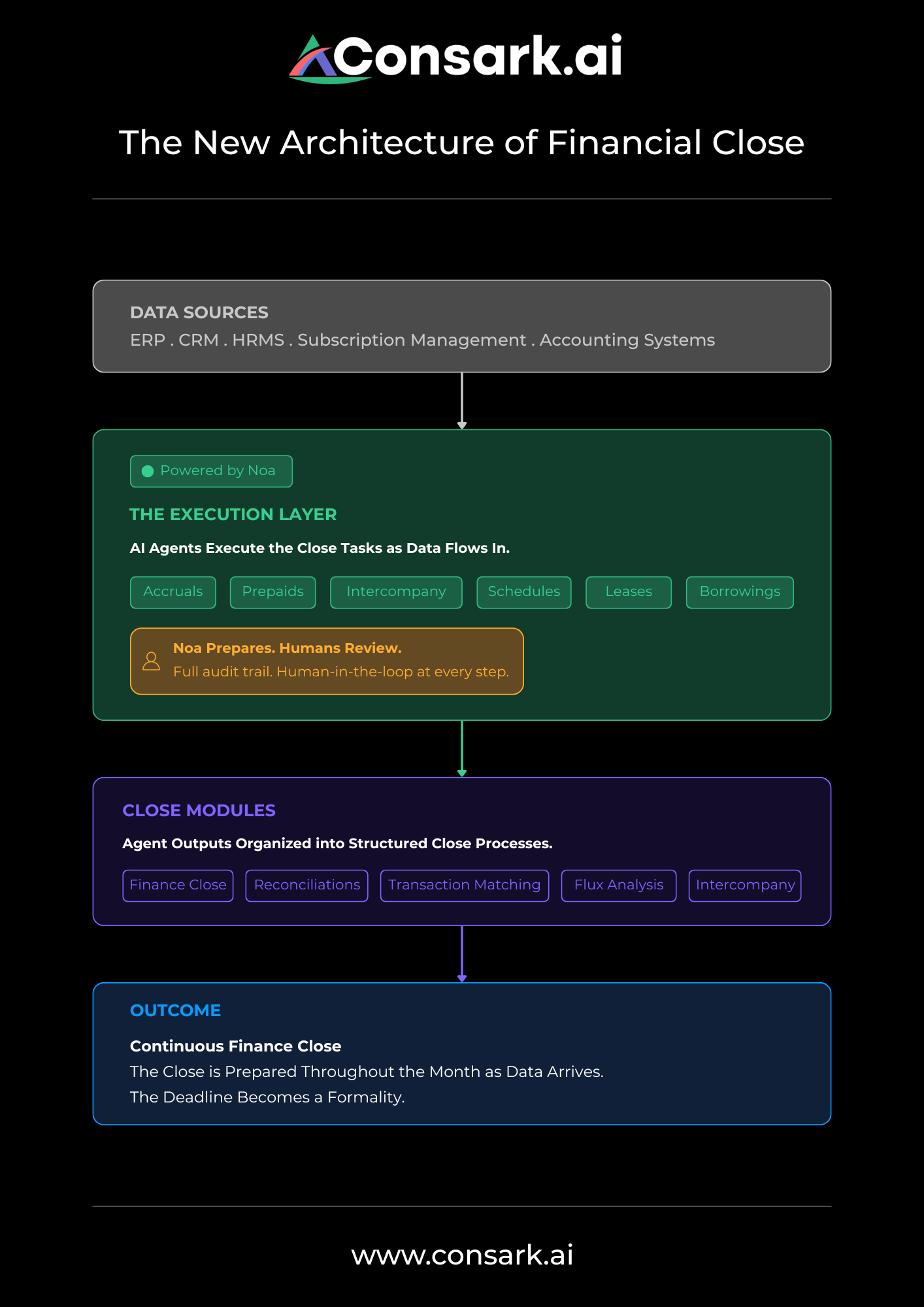
Building an execution layer is significantly harder than building a workflow tool. A workflow tool needs to understand process logic. An execution layer needs to understand finance. It needs to know that a debit to accounts payable on Day 28 referencing PO-2024-4821 is a prepayment that should reverse in 30 days. It needs to know that an intercompany elimination only applies to intra-group transactions. It needs to know the difference between a timing difference and a genuine mismatch. The companies that get this right will not be pure technology companies. They will be finance companies that happen to build technology.
That is what we are building. Noa is the first purpose-built execution layer for the financial close.
Imagine your next close. You walk in on Day 1. The accruals are prepared. The reconciliations are done. The intercompany entries are posted. The exceptions are flagged and waiting for your judgment. You didn’t ask anyone to start. Nobody stayed late. The execution layer just ran.
Your job now is to review, approve, and move on. That is what the close should have always felt like.
We built Noa for exactly this. Not to manage the close. To run it.