Financial Close Automation Software for Enterprise Finance Teams

Reconciliations, matching, journals, and variance explanations are prepared continuously by Noa as data flows from your ERP and other systems.
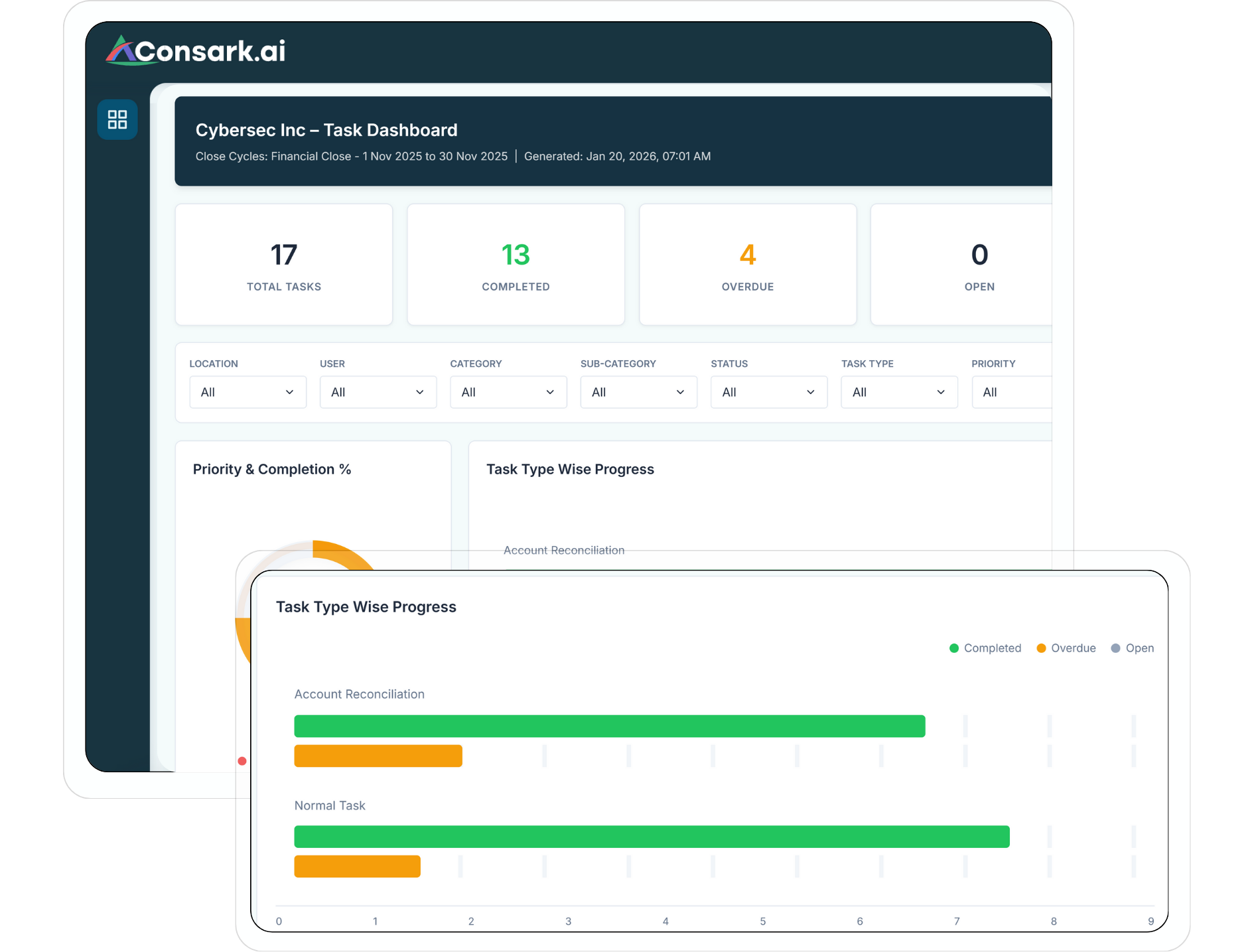
Prepared-Financial-Close

How the Close Prepares Itself

If the numbers move, the system responds.

Noa AI That Stay on Top of Your Numbers.

Consark’s Noa AI Agents remain continuously connected to your ERP and sub-ledgers, monitoring financial activity as it happens.

Trial balance movements tracked as they post.
Transactions are monitored across sub-ledgers and intercompany.
Balance changes detected without waiting for period-end.
Preparation runs continuously, not periodically.

By the time the review begins, the close is already taking shape.

Noa AI Prepares Before Your Team Logs In.

Core close work is assembled autonomously in the background, following defined accounting logic and policies.

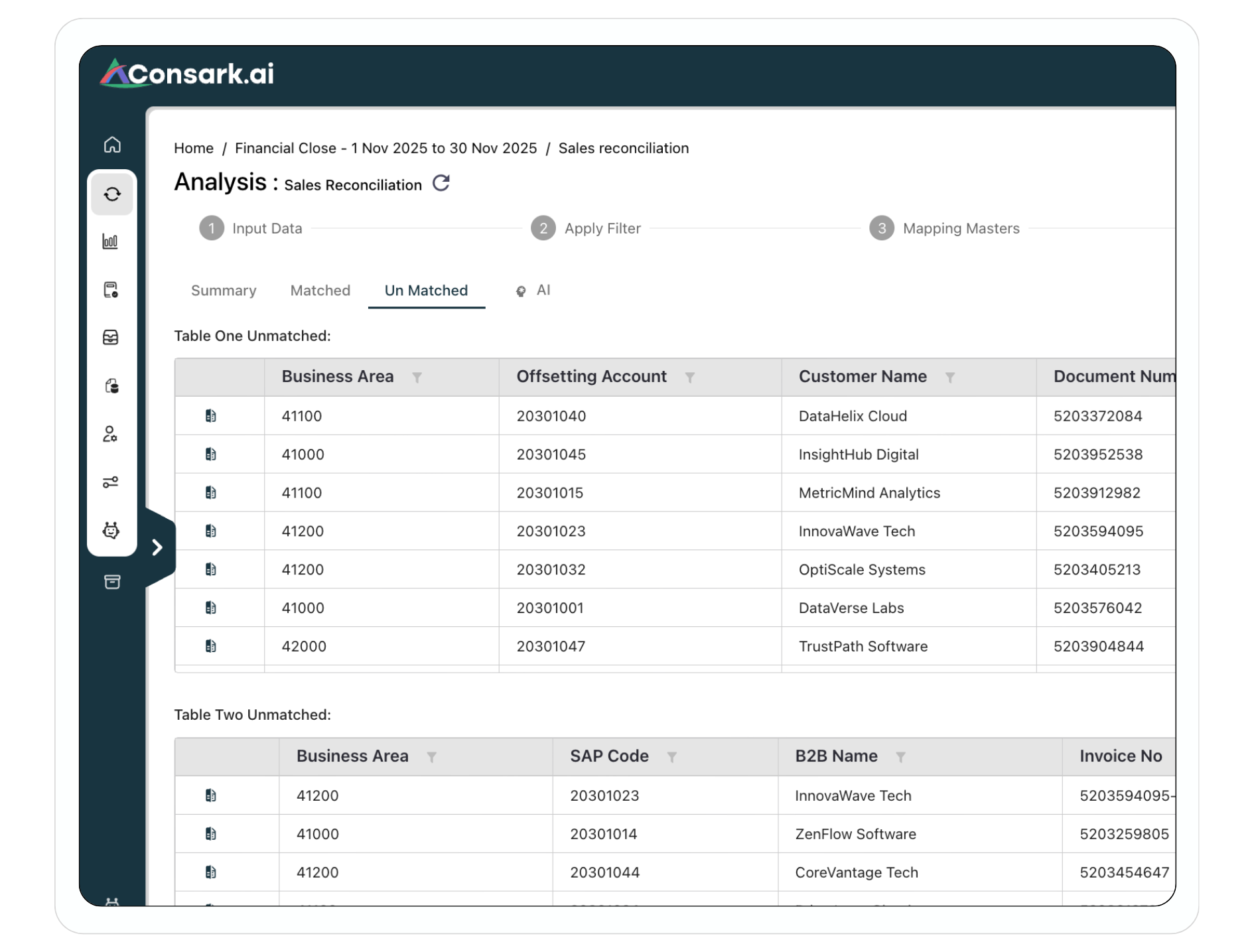
Reconciliation schedules built from trial balance and source data.
Transactions auto-matched using rule-driven logic.
Journals and adjustments drafted with calculations and evidence.
Variance explanations generated from underlying activity.
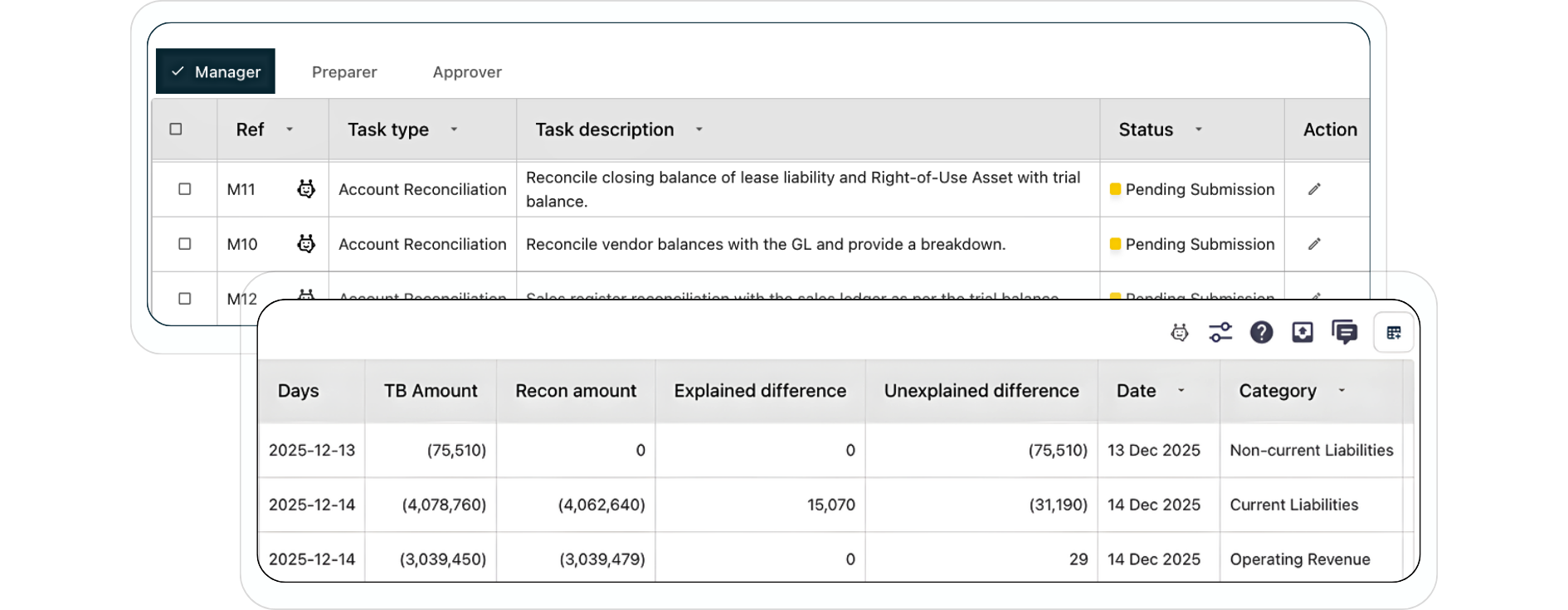
prepared-review-queue
financial-close-exceptions
Review begins with understanding, not investigation.

Exceptions Surface with the Right Context.

Consark isolates only what requires professional judgment and delivers it ready for review.

Material exceptions surfaced based on defined thresholds and policies.
Unreconciled balances and unmatched transactions clearly flagged.
Variance movements surfaced with transaction-level context.
Supporting documents, calculations, and history attached automatically.

At close, teams validate and release with confidence.

Month-End Becomes a Final Check, Not a Build.

Preparation doesn’t peak at month-end. It culminates there.

Work continuously refined throughout the period.
Prepared outputs routed through review and approval workflows.
Reviewer comments, approvals, and timestamps preserved.
Outputs remain traceable from source data through reporting.
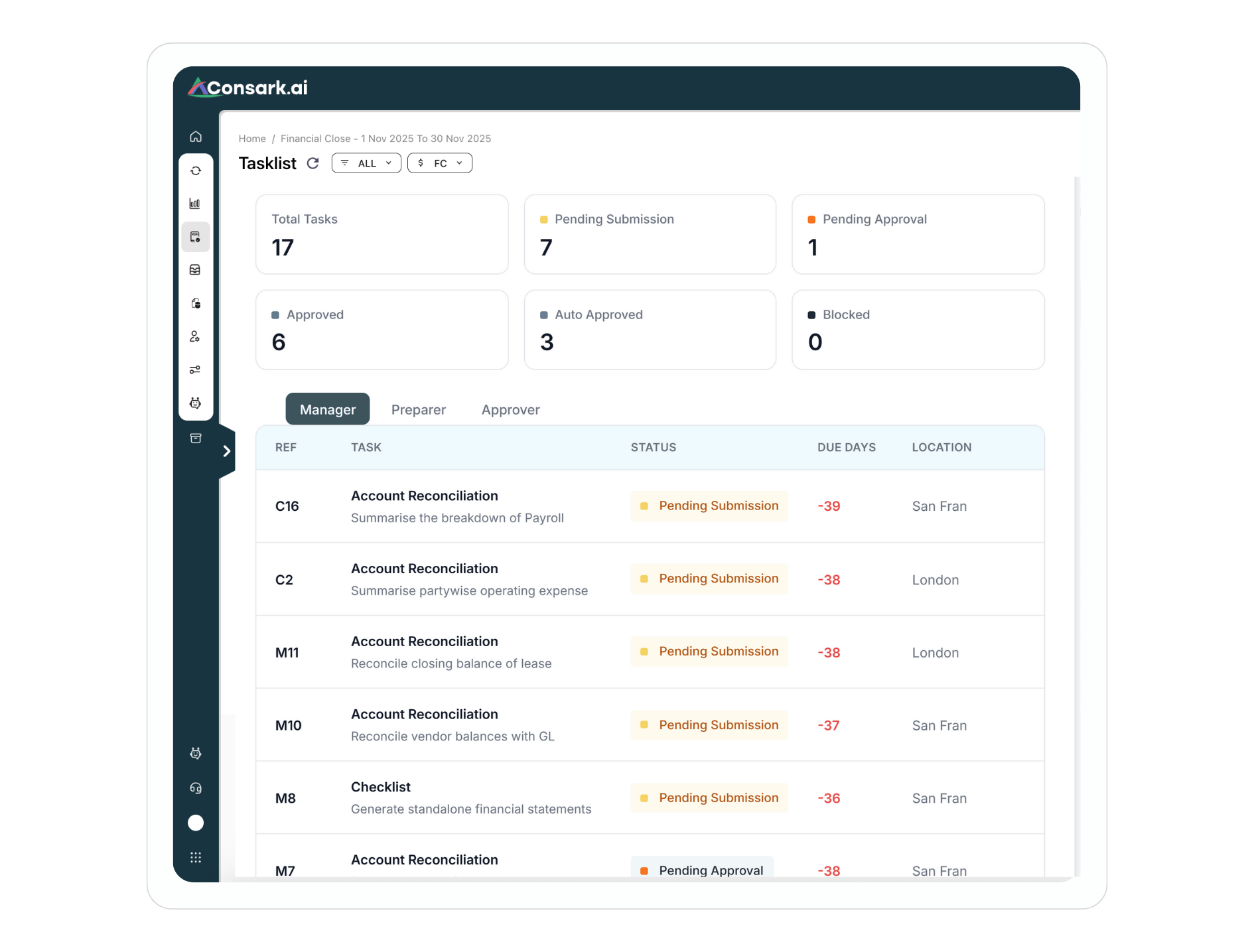
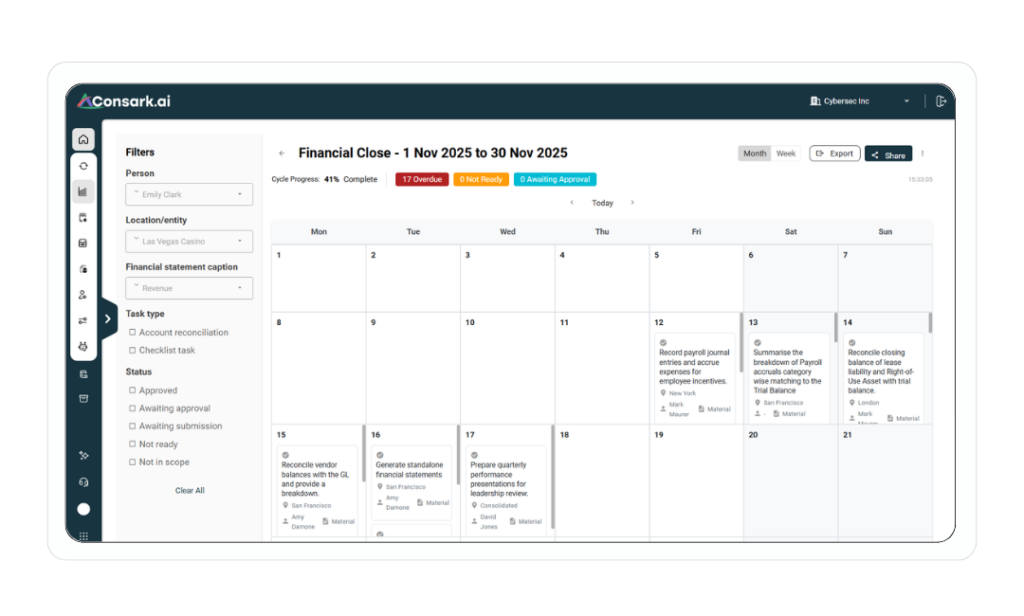
Accounting-Manager-Tasklist
Used by finance teams operating at enterprise scale.

What Finance Teams Are Seeing in Practice.

FAQ

Financial close automation software helps finance teams automate the recurring tasks required to close the books at period end. This includes account reconciliations, transaction matching, journal entry preparation, variance analysis, and intercompany eliminations.

In many organizations, these activities are still managed manually across spreadsheets and disconnected tools. This creates bottlenecks, increases risk, and puts pressure on teams working against tight deadlines.

Financial close automation software replaces this with AI-driven workflows that prepare close tasks continuously. It surfaces exceptions for review, standardizes processes, and maintains a complete audit trail from source data through to financial statements.
The financial close process is the set of accounting activities required to produce accurate, auditable financial statements at the end of a reporting period.

It includes reconciling balance sheet and income statement accounts, matching transactions across sub-ledgers and ERPs, preparing and posting journal entries, completing intercompany eliminations, generating variance commentary, and obtaining sign-off from Controllers and CFOs.

In complex, multi-entity enterprises, the close is not a single workflow. It is a coordinated effort across teams, systems, and stakeholders, often compressed into a narrow window of five to ten business days.
Financial close automation works by connecting directly to your ERP and source systems and applying accounting logic throughout the reporting period.

AI agents monitor transaction activity, identify reconciling items, match transactions based on defined rules, draft journal entries with supporting calculations, and flag exceptions that require review.
The most effective implementations follow a continuous close model, where preparation happens throughout the month instead of only at period end. Finance teams review and approve prepared outputs rather than building them manually, with every step fully traceable from source data to final statements.
An ERP records financial transactions and maintains the general ledger. It acts as the system of record.

Financial close software works on top of the ERP. It uses underlying data to automate the workflows required to close the books, including reconciliations, exception management, and journal preparation.

ERPs are not designed to execute close processes independently. They rely on manual effort from finance teams to complete critical tasks. Financial close automation software fills this gap by transforming ERP data into prepared, review-ready outputs, with controls and auditability built into the workflow.
Automating the financial close helps finance teams move faster with greater accuracy and control.

Key benefits include shorter close cycles through continuous preparation, fewer errors from automated reconciliation and matching, and stronger audit readiness with full traceability across every close activity.

It also reduces risk by surfacing exceptions earlier in the process, rather than at the deadline. As a result, finance teams spend less time gathering and preparing data, and more time reviewing results and driving analysis.

For multi-entity enterprises, automation removes the need to manually coordinate inputs across subsidiaries, making the close more structured, predictable, and scalable.

From month-end panic to perpetual preparedness.

Move to an autonomous close with accountability built in.